2025 Year in Review

It is already early May, and I still have not written my year in review. This one had more time to marinate than usual: my previous record was late January, and now it is almost summer. So it is time to pull everything into one place before the details drift too far into notes.
Systems and Projects
TravelLab: Home Server
This year TravelLab started to feel less like an experiment and more like boring infrastructure, in the best possible way. Not much changed here, aside from the usual periodic upgrades to the latest versions. That is probably a good sign: when a home server stops asking for attention, it has finally become infrastructure. I am also thinking about setting up backups of all my GitHub projects to TravelLab.
I have now removed Anytype from TravelLab and moved it to a cloud VPS, so I always have access even without a VPN. The backup still exists, and everything is encrypted. I did it because I am not the only person using this Anytype instance, and asking other people to turn on a VPN just to access notes was inconvenient.
- Set up a manual TravelLab backup to Amazon S3 Glacier - I make one every couple of months.
- Cleaned up the Ansible setup that manages everything and removed unused services.
- Added periodic Garmin watch data backups to TravelLab as well.
- Still on the list: upgrade TravelLab to Ubuntu 26.04 LTS.
Anki and Languages
Anki became a good example of something that simply works, and that is exactly what makes it good. I am still going through cards from last year. I have not added new ones yet, so there is not much to update here.
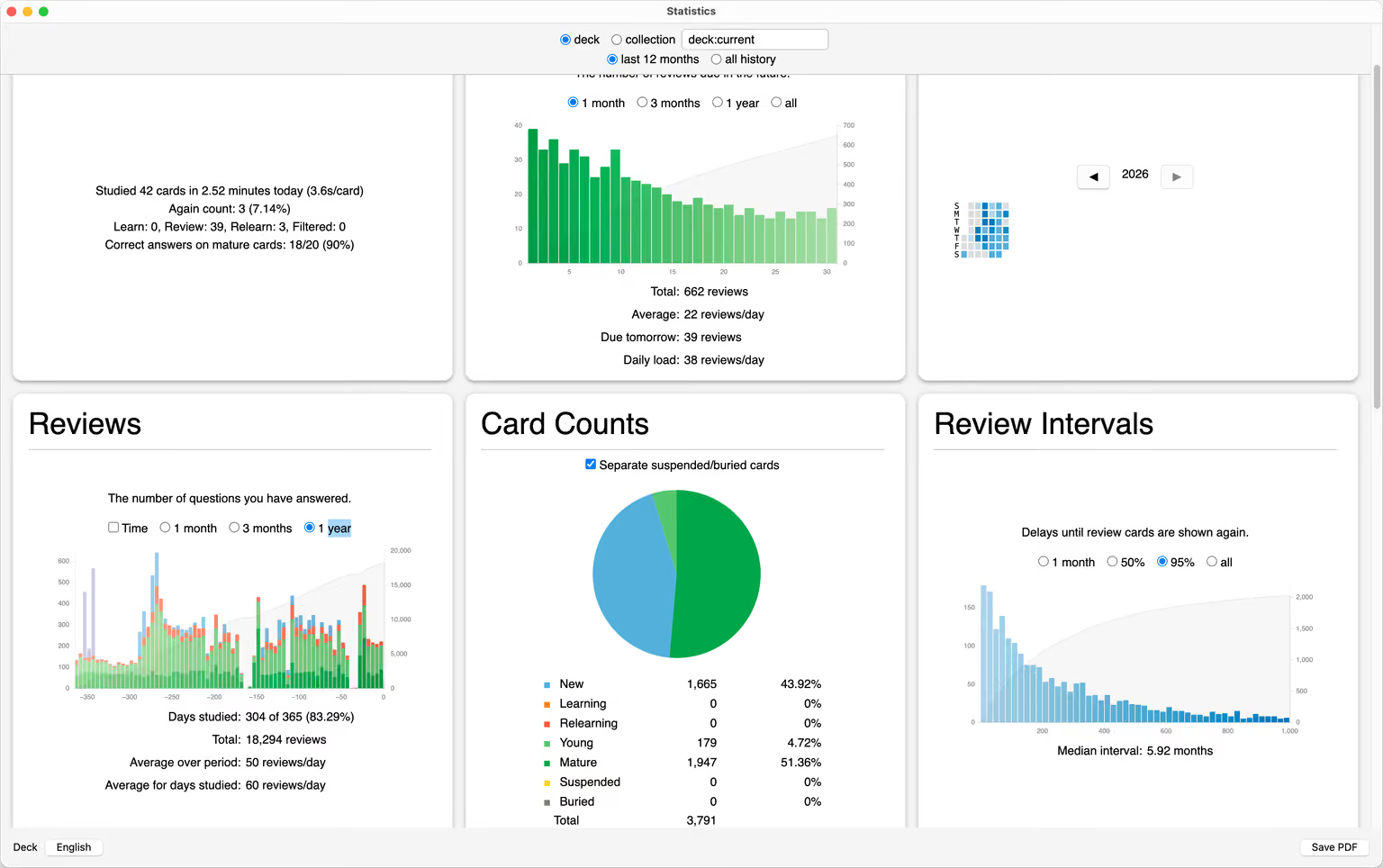
I have already realized that I can simplify my scripts a lot, especially the ones tied to Gemini 2.5 Pro and ElevenLabs. Nothing is on fire there, though, so I will leave that for later. Maybe I will write a separate post about making cards and mining words.
I read The Hobbit, The Hound of the Baskervilles, and Solo Leveling, and added them to Anki. I also bought an 8Bitdo Micro Bluetooth Gamepad, which is convenient when you are studying words and want to walk around the room or do something else at the same time.
Every year I also check my vocabulary size. This year I took the tests near the end of the year, and the result was 9888 - 11396 words. Right now I seem to be stuck around 10 thousand words; last year it was about 9-10 thousand as well.
Blog
The blog migration also happened this year. I do not want to pretend it was some dramatic migration. In practice, it feels like the same kind of infrastructure work as TravelLab or my card scripts: a little boring while you are doing it, and then quietly satisfying every time things get easier. I started using Astro for the blog. The design and most of the blocks stayed almost the same, but live reload is easier now and components are easier to build. I also moved from Cloudflare Pages to Vercel.
Devices
MacBook Air 13 M4, 24 GB RAM
This year I started using an Air in addition to the Pro. The Air handles most tasks really well, and I like how portable and light it is. Maybe at some point, after a few generations, I will fully switch to the Air, but right now I would not have enough memory there to compile and test everything.
iPhone 16 Pro
Last year I wanted to replace my old iPhone 11 with a new phone, and I finally did it while I was in Dubai. When you skip several device generations, every upgrade feels like a proper wow moment. I decided to try the Pro because of the cameras and the screen, and I do not regret it. The cameras really are much better now, especially in low light.
I thought about Android vs. iOS and chose iOS again because of the ecosystem and how easy it is to move to a new device. I use AirDrop, Universal Clipboard, and book syncing between devices all the time.
Side Projects
any-sync-bundle
I made any-sync-bundle - a bundle for self-hosted Anytype. It became my most popular project, and at the time I received several thank-you emails about it. The Anytype authors mentioned any-sync-bundle in their tickets as a good option. That was unexpectedly nice: I built a utility for myself, and it turned out to solve a real pain for other people too.
It was built to simplify running their server and avoid requiring 10+ containers.
NearWord
I started building NearWord. The idea came to me while I was playing Disco Elysium. It is an app that lets you translate any word on the screen: just hover over it, press a hotkey, and the game does not turn into a constant alt-tab session. It works locally, but there is also an optional online mode with better translations. For now I am only working on macOS, but Windows and Linux builds are already ready.
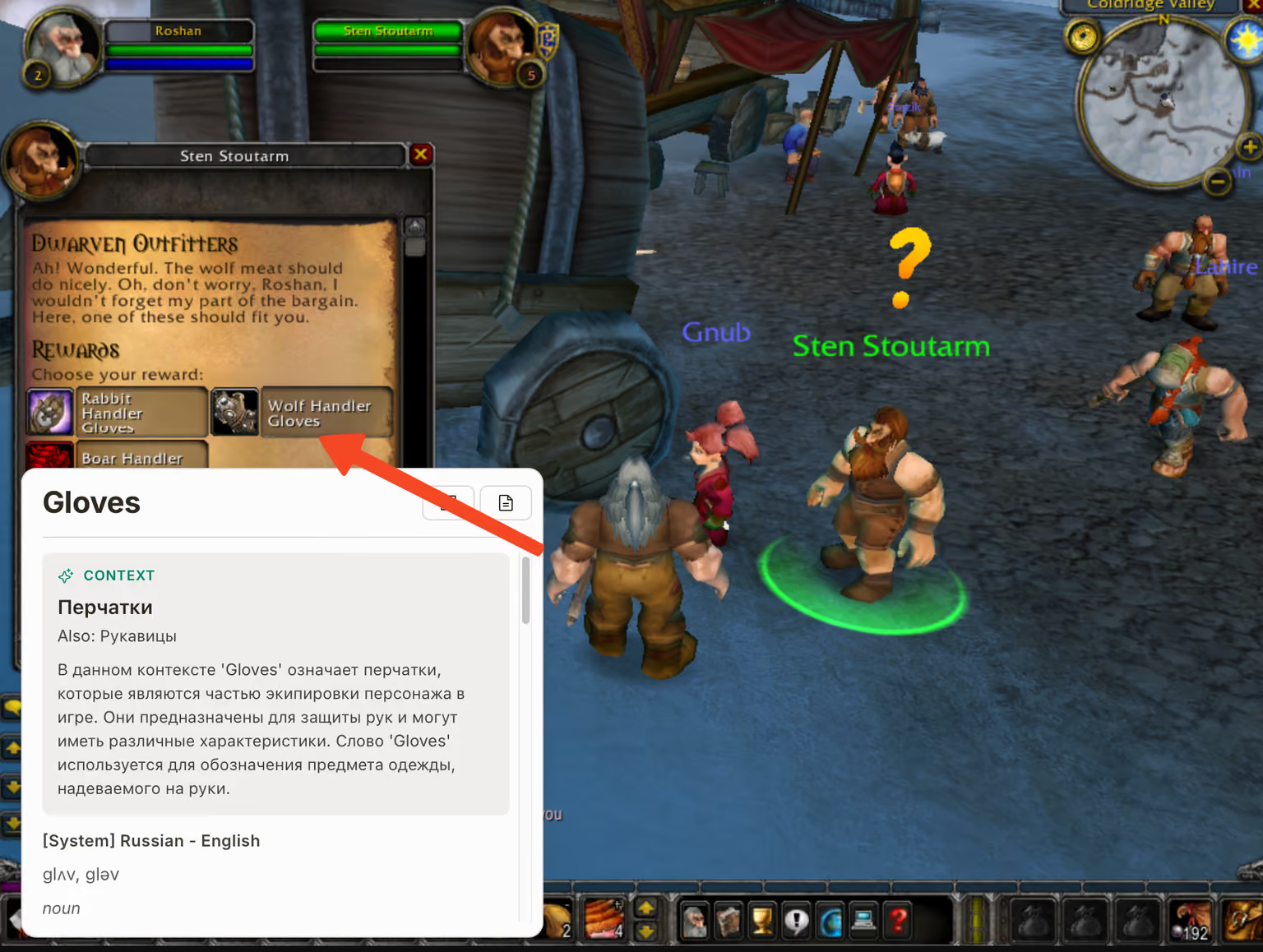
In 2025 I built the foundation and the MVP, then showed it to friends. In 2026 I need to turn it into something people can actually use.
The funny infrastructure bit: because this is a desktop app, I first spun up three local virtual machines to build it. I used Parallels Desktop, started macOS, Windows, and Linux on them, and connected them to the repository as CI runners. It sounds fun until you have to maintain it. In the end, I switched to using paid GitHub Actions machines. That turned out to be much faster and much calmer.
Travel
There were a lot of trips this year, and they were all different. This time I decided to use real photos from the trips instead of stock photos from Unsplash.
I even built new components for galleries and captioned images for this.
Georgia: Tbilisi
Tbilisi left me with a lot of small places this year that I do not want to forget. It is a city of cheap taxis, excellent internet, lively courtyards, and the feeling that one more strange little place is waiting around the corner.
At the same time, Georgia is not always easy for me to walk around in, or at least Tbilisi is not an easy walking city. In much of the city the roads are broken, the sidewalks are narrow, and in hot weather the air feels heavy. I like Vake more; the city feels like it can breathe there, especially around the new park they opened. Also, water or electricity would sometimes go out for a while.
Small places that stuck with me: 41 Gradus bar, making khinkali, shawarma in Didi Digomi, a shoti spot in the old part of the city, and a movie theater in Tbilisi that serves food during screenings. There was also a trip to Kazbegi and Rooms Hotel Kazbegi. I also took a couple of tours again, to Mtskheta and through the old town. As usual, lots of cats and churchkhela.
I liked the cooking class. It turns out khachapuri is not that hard to make, especially if you know a good dough recipe. We wrote it down for the future.
The desserts at Lime also stood out. It is a place that makes desserts for many cafes around the city.
There are also neighborhoods with Japanese cafes and communal ramen cooking. Someone learns to make the noodles, someone else chops vegetables, and then everyone eats together.
On the other hand, things usually work from Georgia without restrictions. The country is probably too small for services to pay attention to it and add restrictions or extra checks, the way they sometimes do for users in Europe or Russia, where you may need to verify yourself or upload extra documents.


Tbilisi is green, and the hills around it are green too. For events, the city gets decorated and starts to feel especially cozy.
We visited the cat we named Busya. She lives near the synagogue, across from a Chinese restaurant. In the evening, the cook from the restaurant would come out and bring them meat and leftover scraps from cooking. It is clear why they are so “fluffy.” While we lived there, we occasionally fed the kittens we nicknamed “hippos.”
If you are a cat person or a dog person, the city is a great place to live. Almost every courtyard has its own local favorites. The locals, though, are already not very happy when tourists feed street animals too actively.
On the trip to Kazbegi, we bought wine at monasteries. It turns out some men’s monasteries have wineries, while women’s monasteries make different sweets, candles, and soap.
Israel: Tel Aviv
So far, Tel Aviv feels like it has some of the calmest and most open people I have met. This time we walked a lot through the Jaffa markets, with stalls full of jewelry. From the food, I remember fish and chips, a place I go to every time I am in Jaffa, and ice cream at Anita. It is easy to remember that place: it is just ice cream, and somehow you end up going back.
The housing gave me a strange feeling. Everything is expensive, but not always well made, even when it costs a fortune. I also remember that people would leave unfinished food on benches instead of just throwing it away.


Tel Aviv has great, convenient packaging for shawarma and pita. They use these plastic sleeves, so nothing gets soggy. But as usual, the portions are huge, even though I like that. You can order a salad and eat it for both lunch and dinner.
Jerusalem
I do not want to make this a separate full section because I was there for literally one day with a tour. There is a decent cafe on the way out of the city; the windmill photo is from there.


Germany: Berlin
Germany stood out on this trip because every city felt different: big Berlin, calm Erfurt, convenient Munich, and a short rainy Stuttgart visit. Starting with Berlin.
In Berlin, I remember the good contemporary architecture and the greenery. From what I saw, apartment buildings often feel well thought-out and well built. At the same time, the contrast is still strong. On one street there is some half-abandoned club, and nearby there is a new residential complex. I liked the way the buildings were designed and the combination of metal and wood. It is pleasant to walk around the city, and the parks are excellent, but to me it definitely did not feel like the cleanest city in Germany. There is also a lot of bad graffiti, and not in a romantic way. Berlin always feels a little unfinished, but that is part of why it is interesting to walk through.
I also saw a fox just running through a park in the city center. In general, I like how yellow and black show up in German design; I think the combination works really well.
We stayed not too far from the center, with a view of the Spree. We got lucky with the weather this time. We walked a lot through parks and around the city.


Germany: Erfurt
Erfurt is a compact, gingerbread-like city. It is very calm and relaxing. It reminds me of a well-kept, wealthy version of Pskov in Russia: also historic, but noticeably more orderly. I bet it feels great at Christmas, when everything is decorated.
I tried Thuringian sausages. There are not that many places there, but overall they were all pretty good. The postcard design also stood out. I would say they were the best postcards I have seen. Both the paper and the style fit the city perfectly. They look like something from a children’s book.
We were at a market there too; the bench photos are from the market. German cities look great in the rain, and we happened to get rainy days a couple of times. In terms of transit, the tram fits the city perfectly as it moves through the streets.
We were unlucky with the hotel Wi-Fi, though. You could basically say it did not exist. I went to the cafe next door, which was part of the hotel. Or maybe the hotel was part of the cafe; it was hard to tell.


The last photo is a shopping tote I bought somewhere near the center in a regular grocery store. I use it now. It reminded me of the plastic Carrefour bags in Georgia with Georgian ornaments on them.
Germany: Munich
After Berlin, Munich initially felt almost small, but I eventually walked myself into it. It is a beautiful, easy city. Walking there is a pleasure: lots of greenery, and in the summer it is not hot but just comfortable. We mostly came because of the BMW museum and factory.
We stayed at Bob W Munich Schwabing, and it was the coolest hotel I have ever stayed in. Everything is handled remotely and through an app, there was a great coworking space on the first floor, and the rooms were very well designed.
There is a lot of Gothic architecture in the city, and I realized I like it too. We saw city gardens that reminded me of the plots in Stockholm that people rent and use to grow vegetables.
I tried fondue for the first time, and it was great. We walked into some random restaurant with good reviews. What did not really stick, though, was the cuisine. It is tasty, but somehow not very memorable.
There were many city events, and I kept getting some kind of sausage at every stop. The parks turned out to be some of the best equipped. We were walking around and found a large area in the center with food, drinks, and a lot of people. There were also many different exhibitions and events. We went to a Japanese exhibition/installation where we made and printed cards ourselves. You layer different parts of the image several times with different colors, and in the end you get the final image.
By the way, the stores had a large selection of non-alcoholic beer. I did not expect that kind of variety.
We also went into antique shops in the city several times. They can be in courtyards or basements, and once you go in, you can get lost in them like in Narnia. It was hard not to buy anything, but we wrote things down and maybe will come back later.


BMW Museum in Munich
The main reason we went to Munich was the BMW museum. I had been given a tour of the factory and museum as a gift. So we spent the whole day on the BMW campus. It is like a city inside the city: they have their own fire service and security because the area is so large (buses run inside it) that municipal services could genuinely get lost there.
We walked through almost the entire production path, from the start of assembly to the final stages. Few people, many robots.
The museum had many iconic vehicles and engines, from aircraft engines and concept cars to the Elvis 507 and the BMW from Need for Speed: Most Wanted. By the way, that visit is what pushed me to try sim racing afterward; on the weekend I drove in Forza Horizon 5 with friends.


Another thing I remember from leaving Munich: the airport had very comfortable loungers and excellent Wi-Fi. Overall, it is a comfortable place to spend time.
Germany: Stuttgart
I was in Stuttgart for literally one day, just to meet up, and I cannot say the city left much of an impression on me. It mostly passed me by. It felt like a standard German city, although maybe a very green one.
I spent more time running through the rain from a store to the parking lot and back than actually walking around. A new train station is under construction there now, and I was basically walking through a construction site because I had taken Deutsche Bahn from Munich. I would say the trains themselves are pretty average compared with France and Spain.


UAE: Dubai
The strangest city of the year, and definitely not a place where I would want to live long term. The whole city feels like a giant mall-city. The taxi service and street cleaning are perfect, but at the same time there is this feeling of sterility and artificiality. Everything is convenient, but it is not always clear where ordinary life is supposed to happen. Even though I liked the hotel, I did not feel the same pull to go outside and walk around in the evening that I felt in Germany.
I liked the Museum of the Future. I made a few perfumes for myself at a generative perfume stand there. You fill out a questionnaire and describe yourself, and they make three perfume variations that might suit you. They mix them right in front of you and hand them over.
I also tried going from the Marina toward the outskirts, but it felt even more bleak there. Riding around the Marina or walking through it is more interesting.
But you need to give yourself a week after arriving to acclimate and learn the rhythm. You walk until 10 or 11 in the morning, go to the beach, and so on. The second time you can go out for a walk is only after sunset, when it is not so hot and the city comes alive. In that sense it reminded me a bit of Spain, where there is even a siesta and places work until lunch, then open again around 8 in the evening.


France: Nice
This was my first time in France, and also my first time in Nice. I really liked it. To me, it felt like a city similar to Alicante or Valencia, but cleaner and wealthier. There is a lot of greenery, flowers, cozy streets, and beautiful views. You can go to the beach and then head into the mountains in the same day. The beaches are pebbly: at first you wonder how anyone lies down there, and then you get used to it.
The food deserves its own mention. I think it is one of the tastiest places I have been. I cannot say the cuisine itself is especially unique, but the ingredients and preparation are excellent. I tried the best pizza I have ever had, made by guys from Italy. Usually in the mornings, while we were walking around, I would get a sandwich from one of the bakeries. I think it was the best bread with butter and cheese I have ever tried.


On weekends, markets opened there where you could buy fresh vegetables, fruit, and fish. We also tried to find local butter, but it is delivered to the city once every week or two and sells out immediately, so we had no luck.
By the way, there was one memorable little absurdity. A climber came down past our apartment because his friend one floor below had slammed the door with the keys still inside. He asked to use our balcony, and while he climbed down to the balcony that had been left open downstairs, we sat with his dog.
Monaco
Monaco is very close to Nice, so we went there by train. Honestly, to me it does not feel different from France. The only things I really remember are that the cars have very short license plates and that you cross the border with France right on a city street. Monaco has an interesting history of how it gained and kept its independence, but now, to me, it looks mostly like a place where rich people live, sometimes directly on their yachts. And, of course, they host the Formula 1 Grand Prix there.


Russia: St. Petersburg
I also visited other cities near St. Petersburg. I was there in fall and winter, so after sunny southern Mediterranean cities I had to get used to the gray weather and search for sunlight.
Overall, though, I liked St. Petersburg, or more precisely the time I spent there. For New Year’s, the city was decorated, and the central streets even started to feel festive, which made walking around more pleasant. The city still has a strong pull, even when it is gray and wet.
Services like food delivery, taxis, scooter rentals, and so on work very well in the city. At the same time, everything is terribly unstable: the connection is awful and constantly drops, worse than the hotel in Erfurt. And the towns near St. Petersburg feel like a “digital desert”: sometimes there is simply no mobile internet, and normal web traffic or sites only work through a VPN.
Overall, I remember the city as a kind of constant low-grade hassle: one thing does not work, then another. Roads get blocked, or the connection gets shut off.


I can imagine living there being pleasant if you are fully tied to local errands, work mostly offline, and your phone is mostly for calls. For tourists, and generally for anyone who wants to visit the city, it is a much rougher deal.
At the same time, there is beautiful architecture and a decent metro and above-ground transit system. There are many places to go and spend time, and near the city there are recreation centers, skating rinks, and so on. Trains between cities run well; you can get to Pskov in about three and a half hours if you can manage to buy a ticket, because the website also does not work properly. I had to buy tickets through some third-party sites.
A Few More Things I Remember
- Sim racing: racing games with a steering wheel and pedals.
- Germany turned out to be very different from city to city: Berlin, Erfurt, Munich, and Stuttgart all stayed in my memory in completely different ways.
- An air fryer is a very convenient thing. You can put the ingredients in, and everything is ready in 15 minutes. Nothing burns, and you do not have to watch the process.
- Building old Flutter apps for new iOS versions is painful. I helped build an app for a new iOS version, and I had to patch and fix a lot of things by hand, including finding answers on Chinese forums.
- One book genre that stood out was LitRPG: I read two series - “Play to Live” and “The Game Is Not for Fun.” I liked them, and after that a friend and I started playing World of Warcraft.
- I finished Baldur’s Gate 3.
- The Nix package manager: I started using it for dev environments so I do not have to fight the correct versions every time.
- I opened a PR against the Go repository: https://go-review.googlesource.com/c/go/+/717340. It is still under review.
- I looked into photogrammetry and took photos of a plot of land and an apartment. I do not know why, but the technology feels very interesting, and so does the process. But it takes practice, just like the next thing.
- I spent time on 3D printing. I printed different things for the home and for my sister, including things for plants.
2025 in Review
2025 turned into a year where a lot moved forward not because of big leaps, but through accumulation: project updates, the blog migration, notes, Anki, household things, trips, and small technical experiments. Years like that are easy to underestimate until you put everything in one list.
What I Want to Keep Going
I do not want to turn this into a strict list of plans for 2026, especially since the year is already underway.
- Keep going with Anki and English. Build a stable 10,000-word base.
- Bring NearWord to the point where people are actually using it.
- Maintain TravelLab and the home infrastructure without unnecessary complication.
- Carefully figure out DeFi without turning it into a big project.
- Sometimes take days without AI, so I do not lose my own thinking.
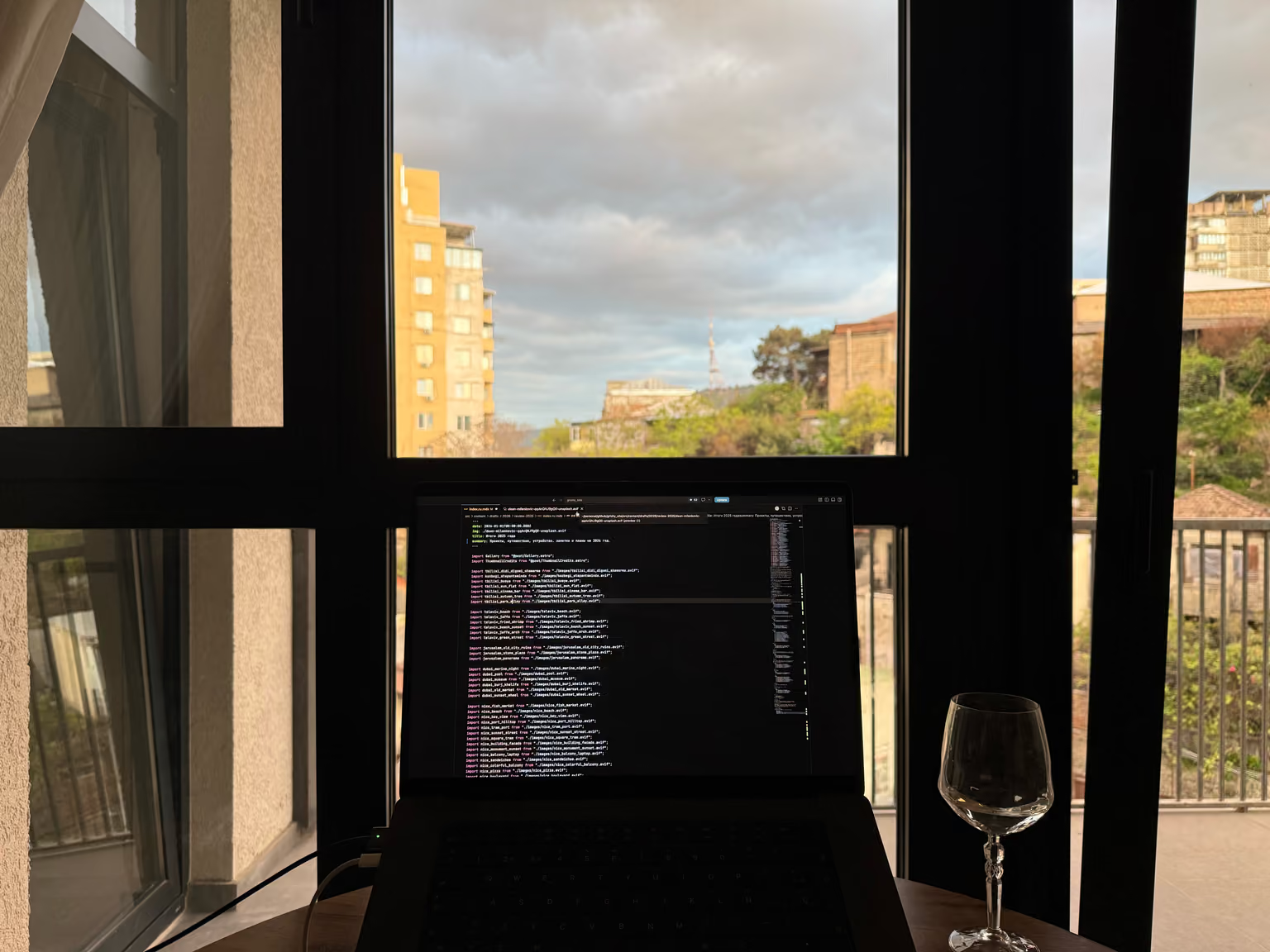
Thumbnail
Font: But Head
Photo by Dean Milenkovic on Unsplash